

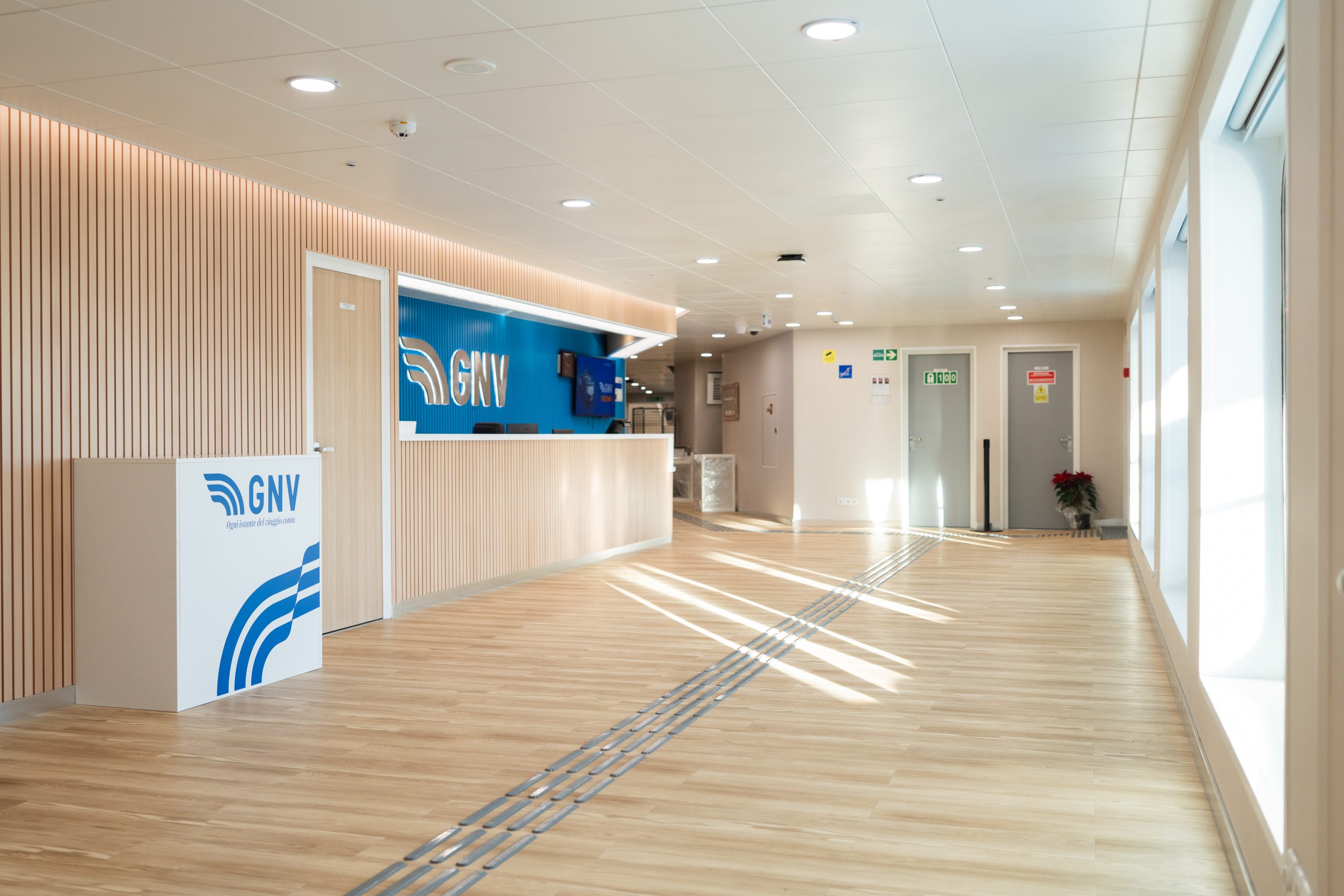
The port of Palermo yesterday evening witnessed the official launch of GNV Virgo, the newest addition to the GNV fleet and the first Italian long-distance ferry powered by liquefied natural gas (LNG), marking a key milestone in the company’s fleet renewal program extending to 2030 and highlighting a shift toward more sustainable maritime transport solutions.
The introduction of GNV Virgo represents a significant step in reducing the carbon footprint of passenger and cargo maritime transport, with the company stating that the use of LNG lowers carbon dioxide emissions by approximately fifty percent per transported unit compared to previous-generation vessels, positioning the ferry as a benchmark for environmental innovation within the sector.
Palermo was chosen for the ceremony due to its historical ties with GNV, as the Genoa-Palermo route was the company’s first operational line, and several recent fleet vessels, including GNV Polaris and GNV Orion, have served this line. GNV Virgo, specifically designed to run on LNG, aims to further reduce environmental impact and enhance maritime transport efficiency.
Technically, the vessel is equipped with advanced environmental systems, including shore-to-ship electrical connection capabilities during port stops and heat recovery systems. It complies with the International Maritime Organization’s (IMO) Tier III standards and the EEDI Phase II requirements. The ship has a gross tonnage of approximately 52,300 tons, a length of 218 meters, a width of 29.6 meters, a top speed of 25 knots, over 420 cabins, a passenger capacity of 1,785, and a cargo capacity of 2,770 linear meters.
The launch ceremony included the presence of national and local officials, representatives of the MSC Group, and GNV executives. The event took place on the port quay near the illuminated vessel, with Italian actor Giuseppe Fiorello hosting, Olympic and world swimming champion Federica Pellegrini serving as the official sponsor, and a performance by renowned ballet dancer Eleonora Abbagnato.
In official statements, GNV’s president emphasized that the launch of GNV Virgo is a cornerstone of the fleet renewal program and emissions reduction strategy. He noted that the ferry was recently fueled with bio-LNG, allowing it to operate for a limited period with net-zero emissions, a performance ahead of European targets, achieved through cooperation with MSC and various institutional and port stakeholders.
The company’s CEO highlighted that the vessel’s entry into service represents a pivotal moment for GNV and Italian maritime transport, reaffirming Sicily’s central role in the group’s investment strategy and underlining the need for modern port infrastructure and operational spaces to ensure service quality and competitiveness.
GNV Virgo is part of a broader fleet renewal program that will see eight next-generation vessels delivered by 2030, three of which are already in service. The GNV Aurora, also LNG-powered, is expected to join soon, alongside four additional units, with ongoing studies exploring the use of bio-LNG in alignment with European and international decarbonization goals.
The first fueling of the ferry for its Genoa-Palermo voyage used bio-LNG derived from organic sources, a fuel with a lower climate impact compared to traditional fuels, although its availability remains market-dependent.
GNV’s ferry operations contribute significantly to the Italian economy, transporting approximately €8.5 billion in goods annually and serving around 2.5 million passengers, supporting tourism and domestic trade. The port of Palermo plays a strategic role in the company’s network for both passenger and cargo transport, with activity levels showing notable growth compared to the previous year.
Founded in 1992 and a subsidiary of MSC Group, GNV operates a fleet of 26 vessels on 33 maritime routes across eight countries, including Italy, Spain, France, Albania, Tunisia, Morocco, Algeria, and Malta.